

Medically reviewed by Dr. Beyza Torun
Published on
Composite veneers in Antalya, Turkey are usually more affordable, require less tooth preparation and can often be completed in one visit. Porcelain veneers generally last longer, resist staining better and provide a more durable result. In Antalya, Turkey, composite veneers typically cost around €100 - €250 per tooth, while porcelain veneers cost approximately €200 - €500 per tooth. The best choice depends on your teeth, budget and treatment goals.
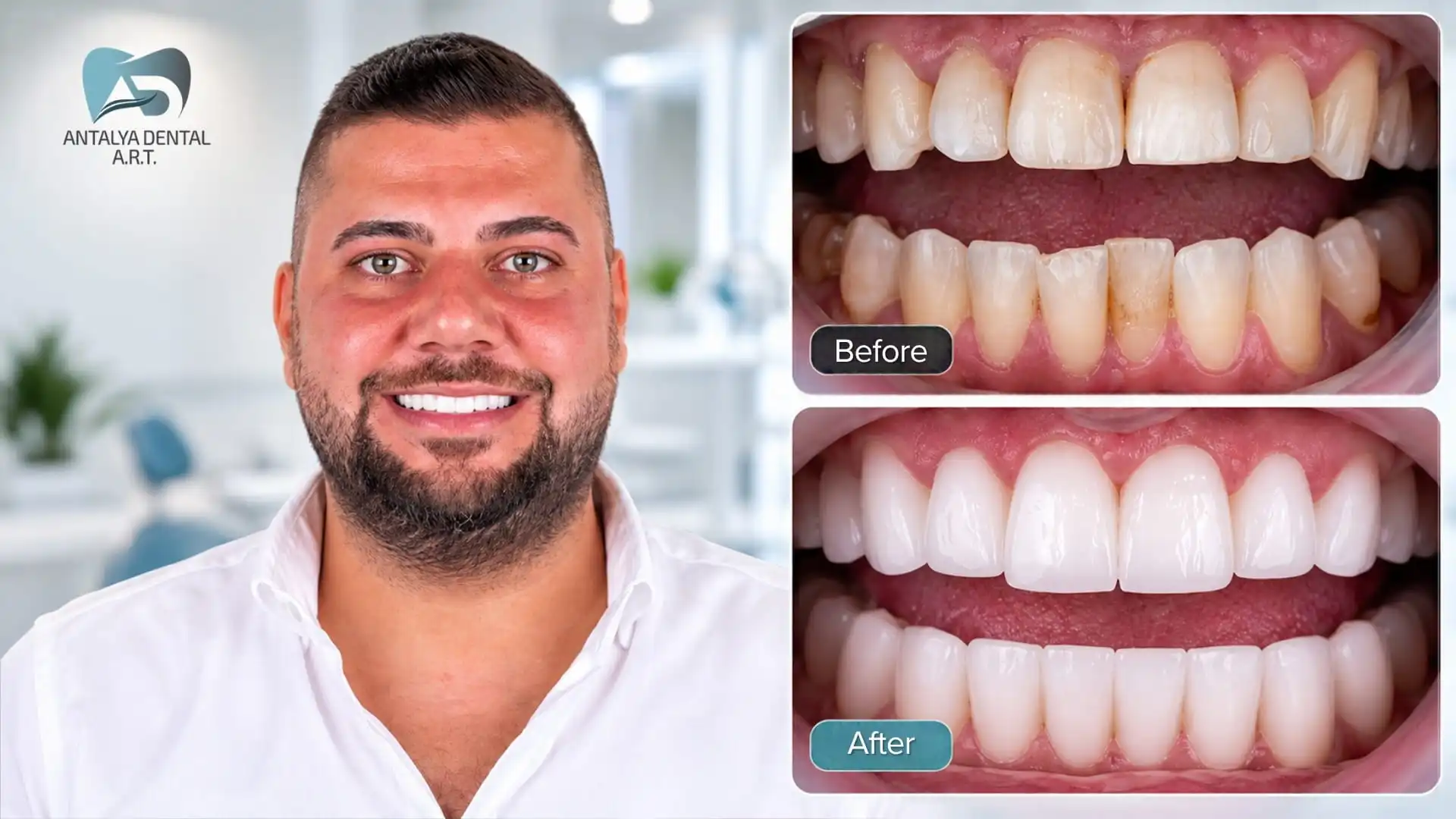
At Antalya Dental ART, options for composite and porcelain veneers are evaluated by taking into account the current condition of your teeth, your oral health, and your aesthetic expectations. A professional examination by a dentist is a crucial step in determining which type of veneer is most suitable for you.
If you are considering getting composite or porcelain veneers in Antalya, Turkey , you can contact Antalya Dental ART to learn about treatment options and receive a personalised price quote.
What are composite veneers?
Composite and porcelain veneers are aesthetic dental treatments applied to the front surfaces of teeth to improve their color, shape, or overall appearance. The primary differences between them lie in the materials used and the application methods.
Composite veneers are an excellent choice for addressing minor chips, cracks, or slight irregularities in tooth shape. In most cases, little to no removal of the natural tooth enamel is required, and treatment can often be completed in a single visit.
What are porcelain veneers?
Porcelain veneers, on the other hand, are thin ceramic shells custom-crafted to fit the front surface of the tooth. These are generally fabricated in a dental laboratory and bonded to the tooth using a specialised adhesive.
Porcelain veneers are used to improve the appearance of teeth, conceal minor chips and cracks, correct discolouration, and close small gaps between teeth. They are known for their natural appearance, resistance to staining, and durability. However, some enamel removal may be necessary during the procedure. For this reason, the treatment is often irreversible.
Composite vs porcelain veneers: What's the difference?
Composite and porcelain veneers both improve the look of your teeth. The main differences are the material, price, treatment time and how long they last.
| Feature | Composite veneers | Porcelain veneers |
|---|---|---|
| Material | Composite resin | Thin porcelain |
| Treatment time | Usually, one visit | Usually, two visits |
| Cost | More affordable | More expensive |
| Tooth preparation | Usually less | May need more |
| Durability | Shorter lifespan | Longer lifespan |
| Stain resistance | Can stain | Stains less |
| Repair | Easy to repair | Harder to repair |
| Appearance | Natural look | Very natural look |
| Strength | Less strong | More durable |
| Lab work | Usually no | Usually yes |
| Replacement | More often | Less often |
| Best for | Quick changes | Long-term results |
How are composite and porcelain veneers applied?
Composite veneers
When applying composite veneers, the dentist places a resin material, matched to the colour of your teeth, directly onto the tooth surface. The material is then sculpted to follow the natural contours of the tooth and hardened using a special light.
Finally, the surface is polished to create a smooth, glossy finish. The entire procedure is usually completed in one session.
Porcelain veneers
The dentist begins by evaluating your teeth. If necessary, a thin layer of tooth enamel is removed so that the veneer can fit naturally. An impression or a digital scan is then taken so the veneers can be prepared in the laboratory. Finally, they are bonded to the front surface of the teeth using a special adhesive.
Because porcelain veneers involve a laboratory process, the treatment typically requires more than one visit. In such cases, temporary veneers can be used in the interim.
Which is better: composite or porcelain veneers?
The right option depends on your teeth, budget and the result you want. Your dentist will consider how much change you need, how long you want the veneers to last and how much tooth preparation is required.
If your teeth only need small changes, composite may be enough. If you want a stronger and longer-lasting result, porcelain is often the better option.
Veneer prices in Antalya, Turkey
Composite veneers in Antalya usually cost around €100–€250 per tooth, while porcelain or E-max veneers are typically around €200–€300 per tooth.
In Europe, porcelain veneer prices are often much higher. Depending on the country, they may range from around €500 to €1,800 or more per tooth.
In the UK, porcelain veneers usually cost around £700–£1,500 per tooth, while composite veneers are typically around £200–£500 per tooth.
Your final cost depends on the type of veneer, the number of teeth being treated, the current condition of your teeth and whether you need any additional treatment.
After a free online consultation, we can provide a personalised treatment plan and a final quote.
Would you like to see our full price list? Visit our prices page, or contact us today for a free online consultation and a personalised veneer quote.
Frequently Asked Questions
No, your porcelain veneers do not stain easily. They have smooth and non-porous surfaces! So, coffee, tea and many foods do not change color of your teeth.
The teeth near your veneers may stain. Be careful with your regular brushing and dental visits.
Yes, small chips can be repaired with composite material. But if the veneer has a large crack or breaks badly, we replace it.
You can use your porcelain veneers around 10 to 15 years, or more if you care! But, composite veneers last about 5 to 7 years.
Your dentist first checks your teeth. He/she prepares veneers if you need. A scan or impression is then taken and sent to the dental lab.
The lab makes thin porcelain shells to match the shape and color of your teeth. When they are ready, your dentist checks the fit and then bonds them to the front of your teeth.
Composite veneers often require little to no removal of natural tooth enamel. For porcelain veneers, a thin layer of enamel may need to be removed so the veneer fits naturally. When enamel is removed, the treatment is irreversible. Your dentist will assess how much preparation is needed for your teeth.