

Dental implants in Turkey
The first thing that comes to mind when you think of dental implants is that placing an artificial tooth root into the jawbone is a painful procedure. However, this idea is completely wrong. If you want the artificial tooth roots to replace your missing teeth and the artificial teeth placed on these roots to be permanent and last a lifetime, you can consider the dental implant option. So what is a dental implant, when is it a good option, what are its advantages, etc.? In the following paragraphs you will find answers to your questions and detailed information about dental implants.
What are dental implants?
A dental implant is an artificial tooth root that is surgically placed into the jawbone to replace one or more missing teeth. It fulfills the functions of a natural tooth and is usually shaped like a screw or cylinder. Dental implants are usually made of titanium, a biocompatible material.
What are the conditions that require dental implants?
- Need to replace a lost tooth or teeth: A dental implant may be placed to replace a single missing tooth. Thus, neighboring healthy teeth will not be damaged.
- Multiple missing teeth: By means of implants, the missing teeth can be restored with fixed dental bridges or removable dentures. The use of implants allows the fixed prostheses, in particular, when the back teeth are missing.
- Missing all teeth (total edentulism): Implants are a stable support for removable dentures in totally edentulous patients. Implanted, retained dentures provide much better retention and stability than conventional dentures. For instance, lower dentures supported by two implants hardly move at all. Usually, four implants are necessary in the upper jaw. Fixed implant-supported dentures are also a possibility in complete edentulism.
- Distal tooth deficiencies: When posterior teeth have been lost (gaps with distal extension), implants allow for the creation of fixed dentures. Such gaps are more challenging to restore with conventional methods, and removable dentures or bridges with long support arms are usually chosen.
- Prevention of bone loss (resorption): After an extraction, the jawbone slowly starts to decline. The dental implant keeps the bone healthy by transferring the load to it and hence bone loss is reduced. Implants stimulate the bone just like natural tooth roots.
- Denture stability and retention problems: Some patients with traditional removable dentures have problems such as slippage or poor fit. Implants provide additional support, greatly enhancing stability and retention.
- To eliminate dysfunctions of the teeth: To improve chewing function: Implants give a chewing function very similar to natural teeth. The chewing function of implant-supported prostheses is higher than other prosthetic solutions.
- Correction of speech problems: The absence of teeth or the use of removable dentures may cause speech difficulties. Implant-supported fixed dentures help to achieve more natural speech functions.
- To fulfill aesthetic needs: Implants create an aesthetically pleasing appearance with the crowns that are placed on them. Especially for the case of missing teeth in the anterior region, aesthetic results are of great importance, and implants can meet this expectation.
- Improving smile aesthetics: Implants positively affect the overall quality of life by raising the self-confidence of the person.
- When conventional prosthetic treatments are not suitable: Implants are an effective alternative solution when anatomical or structural limitations make it difficult or impossible to use traditional bridges or dentures.
Who is not suitable for dental implants?
The determination of individuals unsuitable for dental implants depends on various factors. The factors that decide whether you are suitable for dental implants are:
- Systemic health conditions: Patients with systemic health issues, which may interfere with oral surgical procedures, might not be suitable candidates for dental implants. Examples of such conditions are uncontrolled diabetes, coagulation (blood clotting) disorders, and regular use of steroids.
- Oral hygiene: Those with poor oral hygiene are not proper candidates for dental implants. Keeping good oral hygiene is a must for implant longevity. Not brushing and flossing regularly, or dental visits neglecting, can implant success negatively affect.
- Radiation therapy: Implants may not be the suitable solution for patients who received high doses of radiation therapy.
- Psychological status: Patients with a history of psychotic disorders may not be appropriate candidates for implant treatment.
- Oral and maxillofacial pathologies: Patients with hard or soft tissue pathologies may need to have these issues fixed before getting implants.
- Age: It's not usually a good idea to get dental implants for people under 18 because their bones aren't fully developed yet. It's best to wait until growth is complete before getting implants.
- Pregnancy: Not usually recommended, but in rare cases a doctor's opinion is needed.
- Alcohol or tobacco addiction: Implant success may be adversely affected in individuals with alcohol or tobacco dependence.
- Osteoporosis and low bone mineral density: Bone quality is important for implant success. Patients with osteoporosis or low bone mineral content (decreased alveolar bone density and mass) may pose a risk to implants.
What materials are dental implants made of?
Titanium:
Titanium has high tensile strength and fracture resistance and is biocompatible. It is lightweight and corrosion resistant.
Titanium alloys:
Some dental implants are produced by alloying titanium with aluminum and vanadium. It has high tensile strength. It is biocompatible and integrates effectively with bone tissue. Preferred for use in posterior teeth
Titanium-zirconium alloy:
This alloy has higher strength than titanium, very high biocompatibility, and is compatible with bone tissue.
Zirconium:
Zirconium is a glassy ceramic material. Zirconium dental implants are white in color, making them more desirable for the replacement of missing front teeth. Zirconium has high biocompatibility, which makes it compatible with surrounding tissues and gums.
Tantalum:
Tantalum is a metal with high biocompatibility and durability. It adapts well to the bone. It is a material with a low risk of metal allergy.
Hydroxyapatite:
Hydroxyapatite is a compound containing calcium phosphate. It covers the surface of the implant, facilitating its rapid and solid integration with the bone.
Acrylic:
Acrylic implants, usually made from polymethyl methacrylate, a resin, are biocompatible.
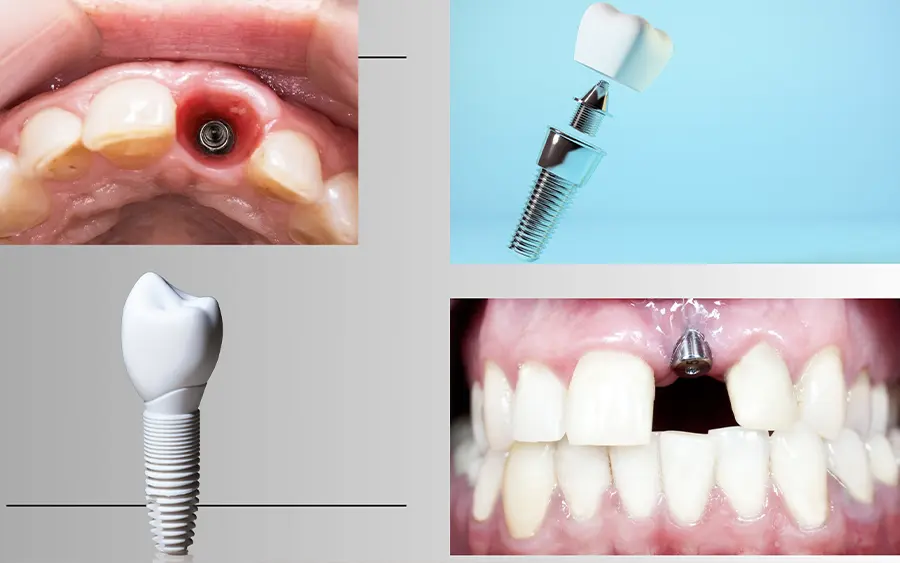
Since dental implants are a long-term investment in your oral and dental health, they must have the following characteristics:
- A well-known, high-quality, and internationally certified brand.
- Be of good quality and resistant to loosening, breaking, and cracking for a long time.
- It must adapt to the jawbone (be biocompatible).
- Chewing function must be fully restored.
- Look like natural teeth.
What does the dental implant system consist of?
A dental implant system includes the dental implant body, abutment, abutment fixing screw and crown.
Dental implant body: The body of the dental implant, which is an artificial tooth root, is the component that is placed in the jawbone through surgery. The body of the dental implant obtains structural stability through osseointegration with the jawbone and becomes the primary support for the next parts.
Abutment: Once the implant body has been placed in the jawbone, a support, i. e. an interconnection, is necessary to hold the artificial tooth. The abutment is the connecting element that links the artificial tooth with the implant body.
Abutment fixing screw: The abutment fixing screw maily helps in fixing the abutment tightly and securely to the implant body. It limits the malfunction of the abutment due to the loosening of the implant or detaching from the implant and keeps it stable.
Crown: The dental implant system includes the topmost filling crowns which are also the parts that visually look like real teeth.
Conditions requiring dental implants: Dental implants are frequently needed in situations such as tooth loss, aesthetic concerns, functional problems, and when other prosthetic treatment options are unsuitable or insufficient.
Dental implants have many benefits. Some important benefits are as follows:
It is usually a long-lasting and reliable treatment option and it has a much higher success rate.
They play an indispensable role in achieving the goal of modern dentistry to rehabilitate functional, anatomical, or aesthetic problems caused by tooth loss.
Provides a foundation for replacement teeth that look, feel, and function like natural teeth.
It provides bone preservation after tooth loss and prevents utilization atrophy.
It can replace all teeth as well as a single tooth.
It can significantly improve the stability and retention of prostheses in people who use prostheses. This helps to improve the quality of life.
Restores dental aesthetics.
Restores lost dental functions (such as chewing and speaking).
Provides maintenance of cavities and maintains occlusal stability.
Can be used as orthodontic anchorage.
Provides comfort and convenience.
It can be a viable alternative to conventional treatment options, and in some cases, especially in severely atrophic mandible, it can be the first-choice treatment for rehabilitation of serious problems caused by tooth loss.
What are the benefits of getting dental implants in Turkey?
In the last few years, Turkey has become one of the most popular places to get dental implants. These are the main reasons why Turkey is a good place to get implants:
Low prices:
Getting dental implants in Antalya, Turkey is much cheaper than getting them in the US, UK, or other European countries. The main reason is that the exchange rates are good. Patients save a lot of money because the costs are lower, even though they use high-quality materials and work with dentists who are experts in their field.
High-quality treatment and technology:
Turkish dental clinics use digital tomography, 3D planning, CAD/CAM technology, and the latest tools and equipment.
Experienced and specialized dentists:
Dentists in Turkey are recognized worldwide, especially in the field of implantology and aesthetic dentistry.
Many dentists have been trained in Europe and the USA and hold international certificates.
Combining tourism with treatment :
Cities like Istanbul, Antalya, and Izmir offer patients the opportunity to combine their treatment with a vacation, thanks to their tourist appeal. Many clinics enhance patient comfort by providing transfer services, accommodation, and interpreter assistance.
If you wish to enjoy a holiday in Turkey during your dental implant treatment, you can contact Antalya Dental A.R.T. Clinic to learn about the services we offer.
Visa ease and transport:
Acquiring a visa for Turkey is a simple process for a large number of citizens from various countries. Additionally, there are some countries whose citizens are allowed to enter without a visa. For instance, the city of Istanbul is linked with direct flights to numerous destinations worldwide.
Preparation:
When you come to our Antalya Dental ART clinic in Turkey, our dentist will determine whether you are suitable for an implant after thoroughly examining your teeth and jaw structure using various imaging methods.
If your bone structure is not suitable for an implant, it will be determined whether additional procedures such as bone grafting or a sinus lift are necessary. Once our dentist has determined that you are suitable for a dental implant, he or she will advise you on the benefits and possible risks and complications of a dental implant.
Determining the treatment plan:
After selecting the implant brand and type with your dentist, a detailed plan will be made, and the treatment will follow this plan.
Placement of the implant body:
The process of dental implant placement is started under local anaesthesia. Incision are made in the gum to open the place where the implant will be placed.
After reaching the jawbone, special surgical instruments are used to create a slot in the jawbone with the appropriate diameter and depth for the placement of the implant body. The implant body is placed in the socket. The gums are then closed, and the healing process is awaited.
Healing varies from 3 to 6 months depending on the bone structure and overall health. During this period, the implant body will become one with the jawbone.
Placement of the abutment:
After making sure that the body of the dental implant is fused with the jawbone, the gum is reopened and the abutment is placed on the implant body. After the abutment is placed, the gum around the abutment is allowed to heal.
During this time, the gum around the abutment starts to heal and gains a natural appearance. This healing process usually takes 1-2 weeks.
Placement of the artificial Tooth:
Once the gums are confirmed to be healed after the placement of the abutment, a prosthetic tooth (fixed or removable) is placed on the abutment.
Proofing:
To ensure the perfect fit and beauty of your prosthesis, you may need a few tries in before the final placement. After the try-in, your dental implant will be tailored to you.
Check-ups and care:
After the implant treatment is completed, you need to go for regular check-ups as per the schedule your doctor will give you. During these check-ups, the condition of the implant and the fit of the prosthesis are checked. To make your dental implant last longer, you should follow your doctor's recommendations.
Dental implant treatment in Turkey is 60-70% more affordable than in European countries, especially the UK and USA.
In the table below, you can find current implant price information and examine the average dental implant cost ranges according to different countries.
| Country | Average Price (€) |
|---|---|
| 🇹🇷 Turkey BEST VALUE | €300 - €1,500 |
| 🇬🇧 UK | €1,200 - €3,600 |
| 🇩🇪 Germany | €1,400 - €2,200 |
| 🇺🇸 USA | €2,800 - €5,300 |
Dental implant prices in Turkey can vary depending on the chosen implant brand, the dentist's experience, bone structure, the scope of the procedure, and the clinic's location. Therefore, the most accurate cost information is determined after a personalized examination and treatment plan.
You can contact Antalya Dental ART, which provides services in Antalya, for detailed information and to get an idea of current costs by reviewing their pricing page.
The following types of implants in Antalya, Turkey are manufactured based on the factors mentioned above:
Types of dental implants in Turkey according to their placement site
Endosteal implants in Turkey
Endosteal implants are implants that are placed in the jawbone and are, in fact, the most commonly used implant type nowadays.
Transosteal implants in Turkey
Transosteal implants include a metal plate and retaining pins that go through the entire thickness of the lower jaw and come out into the mouth.
Transdental implants (endodontic implants) in Turkey
These are pin implants that start from the root canal of a tooth and extend into the periapical bone. They serve to stabilize a mobile tooth. The purpose of these implants is to stabilize and protect the remaining natural tooth instead of replacing the lost one.
Types of dental implants according to design
Root, shaped implants in Turkey
Root, shaped implants may be cylindrical or screw, shaped and have a grooved surface. Most of the dental implants used nowadays are of this type.
Blade, shaped implants in Turkey
Blade, shaped implants are chosen when the bone width is insufficient for a root, shaped implant. They may be prefabricated or made specifically for a certain patient.
Types of dental implants according to the material they are made of
Titanium implants in Turkey
Nearly all dental implants are made of titanium. Titanium is a biocompatible material that a human body easily accepts.
Zirconium implants in Turkey
Zirconium implants are also a metal, free alternative that can be used.
Polymer implants in Tukrkey
While polymers such as polymethylmethacrylate and polyethylene are biologically tolerable materials, they have low mechanical properties and poor adhesion to living tissues.
Types of dental implants according to their diameter
Normal platform implants in Turkey
Usually 3. 5, 4. 5 mm in diameter.
Large, diameter implants in Turkey
Usually wider than 4. 5 mm.
Narrow diameter implants (reduced diameter)
Usually narrower than 3. 5 mm.
Mini implants
Usually smaller than 3 mm.
Types of dental implants according to application time (loading timing)
Immediate loading implants in Turkey
Implants with which the prosthesis is placed immediately or very shortly after implant placement.
Early loading implants in Turkey
Implants with which the prosthesis is placed after a few weeks of implant placement.
Delayed loading implants in Turkey
The traditional way in which the implant is left for several months for osseointegration and then the prosthesis is placed.
Dental implants are a very effective and permanent solution to replace lost teeth, but they also have some disadvantages. Disadvantages of dental implants:
- The price of dental implants is higher than conventional dentures and bridges. The cost may go up even more if there is a need for additional surgical procedures (bone grafting, sinus lifting) during the treatment process.
- The placement of an implant needs a surgical operation; thus, it comes with some risks (infection, bleeding, nerve damage).
- Sometimes, it may be necessary to wait 3 or 6 months for the implant to integrate with the jawbone (osseointegration). The treatment period in some cases may be longer than a year (if there is bone insufficiency).
- Patients who lack enough bone density may need additional bone grafting or sinus lifting, which will prolong the treatment time and increase the cost.
- It is possible to develop an infection (peri-implantitis) around the implant. There is a chance that the implant will be rejected or that it will not bond with the bone completely.
- Implants must be brushed, flossed, and professionally cleaned regularly just like natural teeth. Poor oral hygiene can shorten the life of the implant.
- The implant success rate may be lowered in patients with uncontrolled diabetes, osteoporosis, or immune system disorders.
These are some important things you should keep in mind after implant treatment:
- Once the implant intervention is finished, you are allowed to go home whenever you feel good.
- Some swelling and mild bleeding are normal, so follow your dentist's orders to facilitate the healing process.
- Not engaging in very vigorous activities during the first three days will help avoid bleeding and discomfort after the operation.
- Good dental care through regular checkups (at least two times a year) is essential for the health of the implants and the tissues around them.
- Oral hygiene of the highest standard is very important. This will help to reduce the risk of peri-implantitis (inflammation of the tissues around the implant). Daily brushing and flossing are indispensable.
- Please keep in mind that your implants consist of titanium, zirconium, and porcelain. Although these materials do not decay, implants are vulnerable to gum disease and periodontal problems. It is extremely important to be conscious of the risk factors that lead to gum disease.
- Bruxism (grinding/clenching of teeth) can cause the implants to be under more stress and thus raise the chance of complications. In such situations, your dentist might suggest preventive solutions like wearing a dental appliance at night.
All-on-4 and All-on-6 are new types of implants that help people who have lost all of their teeth or a lot of them.
- The All-on-4 implant technique uses four implants to make a fixed prosthesis. Because the implants are placed at special angles, bone grafting may not be needed. This method quickly fixes the problem by giving patients temporary teeth on the same day.
- All-on-6 uses six implants to give more support, which makes it a great choice for people who chew a lot or have bone density that is on the edge of being too low. Both methods give results that are more stable, comfortable, and natural-looking than regular dentures.
- Turkey has become a popular place for international patients to get All-on-4 and All-on-6 treatments.
Is there any pain during dental implant surgery?
The patient does not feel pain during the procedure because they are under local anaesthesia, but they may feel some slight pressure or vibration.
Is there pain after dental implant surgery?
After the effects of anaesthesia wear off following dental implant surgery, you may feel mild pain and tenderness. This pain may last for a few days. In this case, your doctor will give you pain medication.
Recommendations to reduce implant pain:
- Ice compress (for swelling)
- Regular use of prescribed medication
- Eating soft foods (first few days)
- Avoid smoking and alcohol (slows healing)
What is the duration required to create the slot in the jawbone and position the implant body?
The duration for each implant may range from 30 to 60 minutes. Multiple implant placements could make the procedure take longer.
How long does it take to attach the abutment to the implant body in Turkey?
This procedure usually takes less than 1 hour.
What is the maximum duration after initiating the dental implant procedure before it is completely functional in Turkey?
The duration from the initiation of dental implant application to the conclusion of rehearsals is contingent upon the patient's condition. This duration is a maximum of 6 to 7 months.
How long does a dental implant last in Turkey?
The average lifespan of a dental implant in Turkey is 15-20 years, but this period can be extended with careful use and maintenance.
If there is not enough thickness or density in the mandible, how is the implant done?
In this case, a bone graft is applied. To fill in the missing bone, either add bone powder to the jawbone or transplant bone from another area.
What is the implant placement procedure in Turkey when there is insufficient height or density in the upper jawbone?
In this case, a sinus lift in Turkey is performed. The lower part of the sinus membrane is detached, and a bone graft is placed in the newly formed space. Thus, bone height in the maxilla is increased and the site is prepared for the insertion of an implant.
How long does the implant process take in Turkey for someone who has lost all their teeth?
The standard timeline for implant treatment in Turkey in a patient with complete tooth loss depends on the individual's condition and the planned procedures.
Nevertheless, if we consider the conventional delayed loading protocol, the time from implant surgery in Turkey to the placement of permanent prostheses is usually more than 6 months and can even be up to a year when additional surgical interventions such as bone grafting are necessary.
Immediate or early loading protocols can shorten this period; however, the dentist decides whether these options can be applied. You can get the most accurate information about the duration of the treatment from your dentist after a thorough examination and treatment planning.
What is the minimum number of implants required for dentures?
The minimum number of implants required for dentures depends on the type of denture and your jaw structure. Here are the details:
For lower jaw (mandible):
A minimum of two implants is sufficient for an 'overdenture' (removable prosthesis). The retention of the removable prosthesis increases, and bone resorption slows down. With 4 implants, it becomes more stable.
A fixed denture (All-on-4) requires at least 4 implants.
For upper jaw (maxilla):
Minimum 4 implants: The upper jaw has a softer bone structure, so it needs more support.
For overdenture: 4 dental implants recommended.
For fixed prosthesis (all-on-4 or all-on-6): 4-6 implants are ideal.
Can daily activities continue after dental implant surgery?
After the surgery, you should rest as much as possible for the first 24 hours. The next day, non-heavy daily activities can be carried out carefully. Avoid heavy exercises and intense physical activities for the first few days. Sleeping on your back with your head elevated for the first few nights will help reduce swelling.
Are there any alternatives to dental implants?
Dental bridges and partial or full dentures can be preferred.
How many implants do you need at the very least for dentures?
The type of denture and the shape of your jaw will determine how many implants you need. Here are the specifics:
For the lower jaw (mandible):
- An "overdenture" (removable prosthesis) only needs two implants. The removable prosthesis stays in place better, and the bone resorption process slows down. It gets more stable with four implants.
- You need at least four implants for a fixed denture (All-on-4).
For the upper jaw (Maxilla):
- At least four implants: The bone structure in the upper jaw is softer, so it needs more support.
- For an overdenture, four implants are best.
- For a fixed prosthesis (All-on-4/6), 4 to 6 implants are best.
After dental implant surgery, can you still do your daily tasks?
You should try to rest as much as you can for the first 24 hours after the surgery. The next day, you can carefully do light daily tasks. For the first few days, don't do any heavy exercises or hard physical activities. For the first few nights, sleep on your back with your head raised. This will help the swelling go down.
Are there any alternatives to dental implants in Turkey?
Patients can choose dental bridges, partial dentures, or full dentures as alternatives to dental implants in Turkey.